A strong team wins 1-0 in the Champions League. The person watching the match is happy because they predicted the correct result, but when they open their betting history, they see the ticket marked as a loss. This situation is not rare, especially in matches where the favorite is giving a deep handicap. You predicted the winning team correctly, but you haven't read the specific condition that the team must meet on the handicap market.
Asian handicap doesn't just ask which team wins the match. It also asks how many goals the favorite will win by, or whether the underdog can keep the score within the allowed handicap range. Because of this, a narrow victory might be enough for the team to secure three points, but it isn't necessarily enough for the favorite's ticket to win. With whole ball, half ball, or level ball handicaps, the settlement methods are also different.
Therefore, reading Champions League handicap odds must start with the distance between the actual score and the handicap level, not from the club's reputation. When you understand how to split the 0.25 and 0.75 balls, and differentiate between winning by a clear margin and just winning the match, you will avoid many losing bets caused by misreading rather than by bad predictions. The hardest part isn't the math. It's maintaining your composure when a big team is placed as the favorite.
Key Takeaways
- The favorite winning the match doesn't mean the handicap ticket wins; the goal margin is the deciding factor.
- 0.25 and 0.75 balls are split into two equal parts, creating outcomes like half-win, half-loss, or half-push.
- Whole ball handicaps can return your stake when the score after the handicap is level.
- Pre-match and live bets must be read according to the exact score, timing, and settlement conditions of the specific market you selected.
- An increasing handicap doesn't necessarily mean you should follow the favorite; the new price might have already taken all the advantage.
- If you cannot determine if the strong team can win by enough goals, skipping the bet is a reasonable choice.
Why Does the Favorite Win but the Handicap Ticket Still Lose?
Handicap betting creates a hypothetical score to balance the chances between two teams of different strengths. The stronger team is usually the favorite and must "give" the opponent a handicap level. When the match ends, the handicap is added to or subtracted from the actual score to determine the result of the ticket.
Let's say Team A is giving Team B a 1.5-goal handicap. If Team A only wins 1-0, the professional result is a victory, but after subtracting the 1.5-goal handicap, the score used for betting becomes A -0.5 versus B 0. The favorite's ticket loses. For the favorite to win the bet, they must create a margin of at least two goals.
This is the point beginners often overlook. They analyze the team's form, ball possession, home advantage, and star quality quite thoroughly, but ultimately place their bets based on a conclusion that is too simple: the strong team will win. That conclusion is valid for the 1X2 market, but it is not enough to handle the Asian handicap.
The Champions League is even more prone to creating this confusion because the reputations of the teams heavily influence the bettor's psychology. A club with a rich history facing a lesser-rated opponent often makes the favorite look very appealing. However, the objective of a team in a specific match might just be to secure three points, preserve an advantage, or manage risk. They have no obligation to win by the exact margin that the person holding the handicap ticket requires.
Before risking your money, you should separate two questions. Is the favorite likely to win the match? If so, are they likely to win by enough goals? Only the second question directly determines the handicap ticket.
How to Read Common Champions League Handicap Levels
A minus sign usually indicates the favorite, while a plus sign belongs to the underdog. A -1 line means the favorite must give up one goal; +1 means the underdog gets a one-goal start when evaluating the ticket. Display formats can vary slightly between betting boards, but the basic settlement principle remains based on the handicap level at the time the bet is confirmed.
The table below uses the favorite's result for illustration. The scores are just hypothetical situations, not the odds for a specific Champions League match.
|
Favorite's Handicap |
Favorite Draws |
Wins by 1 goal |
Wins by 2 goals |
Wins by 3 goals |
|
0 |
Push (Stake returned) |
Full Win |
Full Win |
Full Win |
|
-0.25 |
Half Loss |
Full Win |
Full Win |
Full Win |
|
-0.5 |
Full Loss |
Full Win |
Full Win |
Full Win |
|
-0.75 |
Full Loss |
Half Win |
Full Win |
Full Win |
|
-1 |
Full Loss |
Push (Stake returned) |
Full Win |
Full Win |
|
-1.25 |
Full Loss |
Half Loss |
Full Win |
Full Win |
|
-1.5 |
Full Loss |
Full Loss |
Full Win |
Full Win |
|
-1.75 |
Full Loss |
Full Loss |
Half Win |
Full Win |
|
-2 |
Full Loss |
Full Loss |
Push (Stake returned) |
Full Win |
This table shows that the same 1-0 victory can produce three very different results. If you backed the favorite at -0.75, the ticket wins half. At -1, the stake is returned. But if you entered at -1.25 or -1.5, the ticket loses half and loses full, respectively. The prediction of the winning team doesn't change; the financial result changes completely because you entered the match at different lines.
Readers who want to put handicap levels into the context of the tournament can refer to the Champions League 2026/27 League Phase outright betting guide. A dense schedule, objectives for each matchday, and the position of each team in the group stage can significantly affect how the favorite approaches the match.
Level Ball and Half Ball Handicaps
Level ball, usually displayed as 0, eliminates the disadvantage of a goal handicap. Whichever side you back must win the match for the ticket to win; if the two teams draw, the stake is returned. This is not a market where a draw is counted as a win. A draw simply means the ticket neither wins nor loses under the standard settlement rules.
With a -0.5 line, the favorite must win. A draw or a loss results in a full loss. Conversely, someone backing the underdog at +0.5 wins the ticket if that team draws or wins. The half-ball level does not have a push result because after adding or subtracting 0.5 goals, the score used to evaluate the bet cannot be level.
Looking at the betting board, it seems simple, but psychology can easily confuse things. A big team giving 0.5 goals can create the feeling that it's light, making bettors think they just need a win. That "just need" sometimes masks the risk: the match might be more balanced than expected, the favorite might face an unfavorable schedule, or the opponent might actively slow down the pace.
Whole Ball Handicaps
At -1, if the favorite wins by exactly one goal, the ticket pushes, and the stake is returned. Winning by two goals or more is required for a full win; a draw or a loss results in a full loss. The -2 line operates similarly, but the push point shifts to a win by exactly two goals.
Whole ball handicaps often create a feeling of having a layer of protection because there is a possibility of getting a refund. That is true in terms of settlement, but it doesn't mean the bet is less risky in every scenario. If the favorite only wins by one goal when giving a -2 handicap, the ticket still loses fully. The protection layer only appears exactly at the margin equal to the handicap.
It is also necessary to distinguish between a push and a half-win. A push means the corresponding stake is returned, creating no profit. A half-win means half of the stake wins according to the accepted odds, and the other half is returned. These two states are often confused when people check their tickets.
Quarter Ball and Three-Quarter Ball Handicaps
The 0.25 and 0.75 levels are understood by splitting the stake into two equal parts. A -0.75 line is equivalent to half the stake on -0.5 and half on -1. If the favorite wins by exactly one goal, the -0.5 part wins and the -1 part pushes, so the overall result is a half-win on the Asian handicap.
A -1.25 line is split into -1 and -1.5. The favorite winning by exactly one goal means the -1 part pushes but the -1.5 part loses, leading to a half-loss. If they win by two goals or more, both parts win. This is why bettors shouldn't mechanically memorize that "a team giving more than one ball must win by two goals." You need to know exactly whether it is -1.25, -1.5, or -1.75 because the settlement at the two-goal mark is not the same.
|
Original Line |
Two Component Parts |
Result near the threshold |
Settlement Method |
|
-0.25 |
0 and -0.5 |
Match draws |
The 0 part pushes, the -0.5 part loses: Half Loss |
|
-0.75 |
-0.5 and -1 |
Favorite wins by 1 goal |
The -0.5 part wins, the -1 part pushes: Half Win |
|
-1.25 |
-1 and -1.5 |
Favorite wins by 1 goal |
The -1 part pushes, the -1.5 part loses: Half Loss |
|
-1.75 |
-1.5 and -2 |
Favorite wins by 2 goals |
The -1.5 part wins, the -2 part pushes: Half Win |
|
+0.25 |
0 and +0.5 |
Match draws |
The 0 part pushes, the +0.5 part wins: Half Win |
|
+0.75 |
+0.5 and +1 |
Underdog loses by 1 goal |
The +0.5 part loses, the +1 part pushes: Half Loss |
To check a quarter-ball bet yourself, temporarily forget the common names like "level half" or "half one." Just split the handicap into two adjacent lines, split the stake into two equal parts, and evaluate each part individually. This method takes a few extra seconds but significantly reduces the risk of misremembering.
The amount received back also depends on the ticket's odds, the odds format, and the settlement rules of the sportsbook. The table above only describes the winning, pushing, or losing status of the stake. Before confirming, bettors should still check the specific market and display rules of the platform they are using.
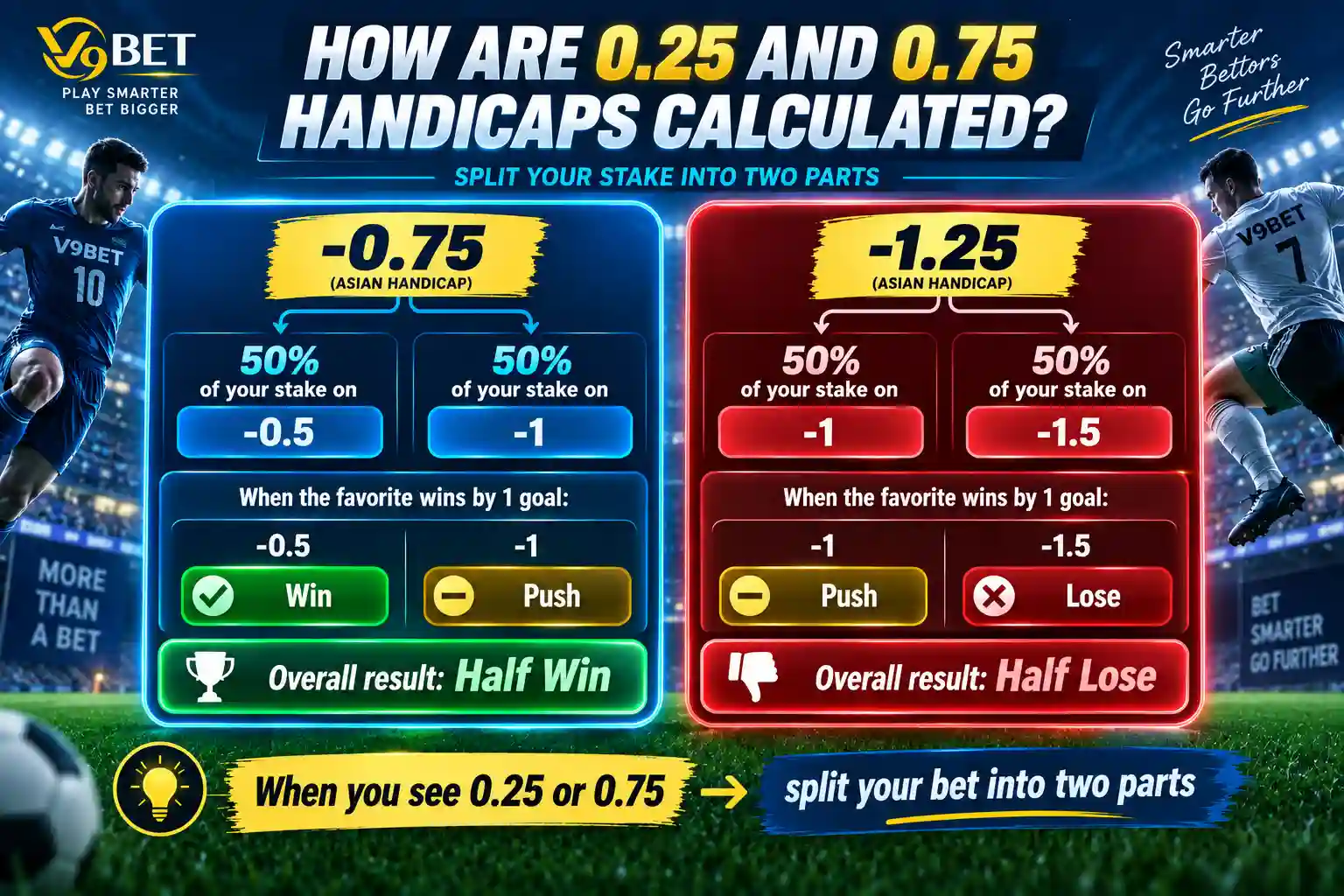
How to split 0.25 and 0.75 Asian handicap odds
Don't Read Handicaps Based Only on Team Reputation
Reputation helps the market set the initial comparison, but it doesn't answer whether the strong team will win by enough goals. A team might control the majority of the match duration while creating very few clear chances. Another team might take an early lead and then slow down, prioritizing maintaining structure over continuing to press.
The psychological preference for strong teams becomes most obvious when the favorite has many familiar faces. Bettors feel safer because they know who they are placing their trust in. However, the handicap has already reflected a portion of that discrepancy. The higher a team is rated, the heavier the condition for winning the ticket usually is. The value of a selection doesn't lie in how strong the team is, but in how much the market has priced that strength into the handicap level.
A similar lesson can be seen in the analysis about deep favorite traps. Even though the context is the Premier League, the principle remains useful for the Champions League: choosing the right strong team is not enough if the bettor has to pay too high a handicap price.
There are matches where the favorite needs a big win to improve their position or goal difference. There are also matches where they only need a result sufficient for long-term goals. You shouldn't infer motivation on your own without confirmed data, but this is a group of questions to check before betting. A team that "wants to win" and a team that "needs to win big" are two different states.
When Does a Deep Handicap Become a Psychological Trap?
A deep handicap is not automatically a bad line. If the gap in quality, playing style, and motivation is large enough, the favorite can still cover. The risk appears when bettors view the high handicap as definitive proof that the strong team will win big, instead of viewing it as an increasingly difficult condition that the ticket must overcome.
Another familiar reaction is seeing the favorite move from a lower handicap to a higher one, then hastily concluding that the market is confirming the strong team. That movement can reflect new information, money flow, or an adjustment by the odds provider. Just looking at the direction of the movement is not enough to conclude the reason, let alone guarantee the result.
An increased handicap also changes the push and loss points. Someone who entered early at -1 can get their stake back if the team wins by exactly one goal, while someone who entered later at -1.25 loses half with the same score. Two people watching the same match, predicting the same team to win, but receiving different results only because of the time they confirmed their tickets.
|
Signal being observed |
Common Misinterpretation |
Questions to check |
|
Favorite's handicap increases |
The strong team is guaranteed to win big |
How does the new line change the push or loss points? |
|
Favorite's odds decrease |
Must enter immediately before the price drops further |
Is the remaining advantage enough to cover the current handicap? |
|
Favorite has more possession |
The next goal is coming soon |
Are they creating clear chances or just circulating the ball? |
|
Underdog defending deep |
They will eventually fall apart |
Does the favorite have a plan to break down a low block? |
|
Early goal scored |
The match will continue one-sided |
Does the leading team need to attack or start managing the score? |
|
Big team is trailing |
The live favorite line is cheap |
Is the game situation really good enough to overturn the deficit? |
Movement is only worth using when placed alongside professional match events and settlement conditions. If the line changes but the way the two teams play doesn't create a clear basis, the reasonable decision might be to continue observing. Experienced live bettors rarely lack opportunities. What they need more is to recognize when a new price is no longer worth following.
How to Read Champions League Handicap Odds at V9Bet Pre-Match
Pre-match, determine exactly what market you are looking at: full-time, first half, or another period. A full-time handicap ticket is usually settled based on the result during official play and stoppage time, and does not automatically include extra time or penalty shootouts, unless the market states different conditions. The rules of each platform remain the final authority and should be checked before placing bets.
After that, convert the handicap level into a worded condition. If the favorite is at -1.5, the condition is: this team must win by at least two goals for the ticket to win. If it's -1.25, winning by one goal leads to a half-loss; winning by two or more leads to a full win. Writing conditions out this way helps your eyes avoid being drawn to team names or odds colors.
The next step is analyzing the ability to meet that condition. Does the favorite create enough chances to aim for the needed margin? Does the opponent tend to sit deep or are they willing to trade attacks? If they take the lead, does the strong team usually keep attacking or slow down? Not every question has a definite answer, but they force the bettor to look at the way to win rather than just picking the winner.
When referencing Asian handicap analysis and line movements, focus more on the methodology of reading the lines rather than blindly applying a conclusion from a different tournament. It might be the same favorite, but the match circumstances, objectives, and specific handicap can change the way it should be handled.
If you are following odds at BTi Sports or SABA Sports, bettors need to re-read the match name, market type, handicap level, and odds on the confirmation slip. This is a simple but important step, especially when many Champions League matches happen close together and odds boards update continuously.
How Do Pre-Match and Live Odds Differ?
Pre-match odds allow the bettor more time to check the context, but haven't yet provided direct data on how the two teams will start. Live odds add real match events, but in return provide a much shorter time to decide, and the handicap can change rapidly based on the score, time remaining, and match rhythm.
A common mistake is bringing pre-match predictions into live odds. A team expected to win big before kickoff might start slowly, struggle in the final third, or lose control after an incident. When that happens, the lower live handicap isn't necessarily a bargain. It could reflect that the probability of creating a goal margin has decreased.
Conversely, a team that hasn't scored but continuously puts the ball into dangerous areas might still maintain a professional basis. However, "pressure" should be read through the quality of chances, not just possession rates or the number of balls sent forward. Lots of sideways passing, long shots without a clear angle, and crosses made in unfavorable positions are not the same as consistently creating direct chances.
|
Criteria |
Pre-Match Odds |
Live Odds |
|
Available Data |
Context, comparison, and pre-match info |
Adds the score, time, and actual match events |
|
Decision Time |
Longer |
Shorter |
|
Handicap Level |
Confirmed before kickoff |
Changes according to events |
|
Psychological Risk |
Easily influenced by reputation |
Easily carried away by goals and immediate pressure |
|
Core Question |
Can the strong team win by enough goals? |
With the remaining time, is the current line still reasonable? |
|
Reason to Skip |
Lack of basis for the margin, or unsuitable price |
Noisy match, line changing fast, or not enough time to check |
There are matches where it is best to watch for a few minutes before deciding. Waiting doesn't mean missing out; sometimes it helps eliminate a wrong prediction about how the game starts. But waiting also doesn't guarantee a better price. Once the handicap has moved too far, or the on-field information is no longer clear, not betting is still a complete decision.
The Current Score is Not the Only Starting Point for Live Odds
When reading live handicaps, you need to look at three factors at the same time: the current score, the remaining time, and the handicap displayed on the market. Don't take the pre-match line and adjust it by feeling. The ticket is settled according to the conditions of the confirmed market, not the level the bettor remembers from the start.
Suppose the favorite is leading 1-0 and a live market continues to require them to give a handicap. The bettor must determine exactly how that handicap applies according to the display and rules of the platform, and also check which score is being used for settlement. Some confusion happens when bettors think they are betting on the result of the remaining period but the market actually evaluates the full-time result, or vice versa.
Also be cautious after a red card, penalty, or a goal just being scored. During those moments, the market might temporarily lock or update quickly. Don't rush to confirm just because you are afraid of missing out. A line that hasn't been fully read doesn't become better just because it is about to disappear.
Live odds are most useful when events clarify what pre-match data couldn't answer. For example, can the favorite actually break down a low block, or does the underdog have enough counter-attacking ability to prevent the strong team from pushing too high? If the match only adds excitement without adding information, the advantage of following live is almost gone.
How is a Half-Win on an Asian Handicap Calculated?
A half-win occurs when the stake is split into two equal parts, one part wins, and the other part pushes. With a -0.75 favorite, winning by exactly one goal means the -0.5 part wins and the -1 part is pushed. The profit is only calculated on half the stake according to the ticket's odds.
Assume you bet 1,000,000 VND at -0.75 with decimal odds of 1.90, and the favorite wins by exactly one goal. The 500,000 VND on the -0.5 part wins, creating a hypothetical profit of 450,000 VND; the 500,000 VND on the -1 part is returned. The total amount returned in this example is 1,450,000 VND, resulting in a profit of 450,000 VND. The actual figure depends on the odds, odds format, and the platform's display.
A half-loss works the opposite way. If you bet 1,000,000 VND at -1.25 and the favorite only wins by exactly one goal, half the stake at -1 is returned, while half at -1.5 is counted as lost. The total capital lost is 500,000 VND.
The notable point is not the multiplication formula, but the splitting mechanism. When seeing a .25 or .75 level, automatically split it into two adjacent lines. Doing this step correctly will make the half-win and half-loss states clear.
Choosing the Favorite Requires Analyzing the Ability to Win by a Margin
A strong team can win through a moment of individual brilliance, a set piece, or an opponent's mistake. Those paths can create three points but aren't necessarily enough to create a large margin. With deep handicaps, bettors need to look for a basis for a second or third goal, not just the opening goal.
The ability to maintain pressure after taking the lead is an important factor. Some teams continue pushing the tempo to finish the game early. Others switch to controlling space and conserving energy. The reaction also depends on the schedule, players on the field, the score, and the objectives of the match. Don't turn an observation from a few matches into a fixed rule for the whole season.
The underdog must also be assessed by their ability to stay within the handicap range. They don't necessarily have to play better or take points for a +1.5 ticket to win. They just need to avoid losing by two goals. This is why there are matches where a bettor predicts the favorite will win but still picks the underdog on the Asian handicap: those two predictions are not contradictory.
Analyzing Arsenal in a deep handicap is an example of separating nominal strength from the requirement to win by a margin. The value of that article lies in its method of asking questions, not in mechanically applying a single choice to every favorite in the Champions League.
When Should You Consider the Underdog?
The underdog is worth considering when they have a basis to keep the match within the allowed handicap range, not simply because the plus line looks big. A team with organized defense, limits central space, and forces the opponent to shoot from unfavorable positions can fit a plus handicap. However, just looking at a low block and concluding they defend well is too big a leap.
It is necessary to look at whether the underdog can hold the ball long enough to relieve pressure. If they lose possession immediately every time they get it, the defensive block can be worn down over time. The ability to counter also forces the favorite to be cautious when pushing their shape higher, indirectly protecting the underdog's handicap.
The handicap remains the center of the decision. Underdogs at +1.5 and +0.75 set very different safety thresholds. At +1.5, losing by one goal still wins the ticket. At +0.75, losing by one goal only results in a half-loss. You can't say generally that "the underdog looks good" without tying the prediction to a specific line.
Bettors also shouldn't choose the underdog just to go against the crowd or to seem different. If the strong team has a solid basis to create multiple clear chances, maintain pace, and continue attacking after taking the lead, the deep handicap can be completely reasonable. Good handicap analysis does not start with liking a side; it starts with the winning conditions of each side.
Mistakes That Cause You to Read the Match Correctly but Still Lose Money
The first mistake is equating a result prediction with a handicap prediction. Bettors spend a lot of time trying to find the winning team but almost never evaluate the margin of victory. By the time the strong team wins narrowly, they see the professional result was correct and think the ticket was settled incorrectly, while the problem lies in the line they chose.
The next mistake is moving to a higher handicap just to get a more attractive odds price. Odds increase because the winning condition becomes harder, not because the sportsbook is naturally paying more for the same probability. Going from -1 to -1.5 is a significant change: a one-goal win moves from a push to a full loss.
Many people also increase their stake when the favorite hasn't scored yet, thinking the live line is "cheap". If the match isn't creating clear chances, a lower price just reflects the time running out. Every passing minute gives the favorite less time to create a margin. A cheap line in numbers isn't necessarily cheap in probability.
After a losing ticket, trying to immediately find the next Champions League match to win it back often lowers selection standards. Bettors start accepting prices they would have passed on before, or increase stakes just to get the account back to where it was. This is when bankroll management is no longer just about dividing a budget, but becomes the ability to stop at the right time.
How to Allocate Funds When Following Champions League Handicaps
There is no fund allocation ratio suitable for everyone. The size of each ticket must be based on the total bankroll you can afford to lose, the certainty of the information, and the limits set before the match. Money intended for living expenses shouldn't be in your betting bankroll.
Suppose you allocate 1,000,000 VND for a whole Champions League matchday. Putting most of that money on a favorite just because of reputation will narrow your ability to handle the remaining matches. A more cautious way is to determine the maximum amount for each decision before looking at odds, rather than letting excitement determine the stake size.
Pre-match and live bets should use the same overall limit. If you already bet the favorite pre-match, adding another bet in the same direction live is not an independent decision; it increases your exposure to the same prediction. Bettors need to add up the total risk of related tickets instead of looking at each ticket separately.
The recap and betting schedule guide provides a useful perspective on recording decisions and controlling the habit of chasing bets. Recording the line at entry, the reason for choosing it, and the settlement result usually helps identify reading errors better than just writing down wins or losses.
Bankroll management doesn't turn a baseless choice into a good one. It only limits the consequences when the prediction is wrong. If you don't understand how the ticket is settled, the most reasonable stake is no bet.
When Should You Skip Champions League Handicaps?
You should skip it when you only know which team is stronger but cannot determine the ability to create a margin. That is a sign that the analysis hasn't reached the right question of the market. A narrow win can be professional, but not enough for the favorite.
You should also stop when the line changes so quickly that the original point of entry no longer exists. There is no need to chase a new line just because you already spent time analyzing the match. An analysis correct at -1 doesn't automatically retain its value at -1.5. When the winning condition changes, the decision must be reevaluated from scratch.
Live bets should be skipped if the match image, score, and odds board aren't synchronized enough to let you understand what you are buying. A few seconds of delay might change the line, but clicking too fast on a ticket you haven't fully read is even more dangerous. Bettors aren't rewarded for participating in many matches; they only face the results of the tickets they confirmed.
Finally, if the choice comes from a need to win money back, close the odds board. That mindset makes bettors look for reasons to bet instead of reasons to decline. There will always be more Champions League matchdays. If the bankroll has passed the limit, a new prediction isn't needed.
Frequently Asked Questions
If the favorite gives a 1-goal handicap and wins 1-0, does the ticket win?
No. With a -1 line, a win by exactly one goal creates a draw after the handicap, so the stake is usually returned. The favorite must win by two goals or more for a full win. If the match draws or the favorite loses, the -1 ticket loses. Bettors should still check the rules of the market and the confirmation slip.
If the favorite gives 1.25 and wins by one goal, how is it calculated?
A -1.25 line is split into two equal parts: -1 and -1.5. When the favorite wins by exactly one goal, the -1 part pushes and the stake is returned, while the -1.5 part loses. The overall result is a half-loss of the stake. If the favorite wins by two goals or more, both parts win.
Does a half-win on an Asian handicap mean receiving half of the total stake?
It shouldn't be understood that way. A half-win means half the stake is counted as a win at the ticket's odds, while the other half pushes and is returned. The total money received includes the returned capital, the capital of the winning half, and the profit generated on the winning half. The specific figure depends on the odds and format.
Does the full-time Champions League handicap include extra time?
Usually, a full-time football handicap market is settled according to 90 minutes of regular play plus stoppage time, and does not include extra time or penalty shootouts unless the market clearly states different conditions. Since rules can differ between bet types and providers, it's necessary to check the market name and displayed terms before confirming the ticket.
Should I follow the favorite if the handicap increases right before kickoff?
You cannot conclude solely based on the movement direction. An increased line can turn a push into a half-loss, or a half-loss into a full loss. You need to reassess the ability to win by a margin at the new level, check confirmed information, and see if the odds are still appropriate. If you can't determine the reason for the movement, waiting or skipping is safer.
Should I switch to live odds if I missed the pre-match line?
Only consider it when actual match events create enough new information. Don't enter live just because you feel you missed a pre-match opportunity. Re-read the score, remaining time, handicap level, and settlement conditions. If the line changes fast or the match isn't clear, not betting is still a valid choice.
Expert Conclusion
Reading Champions League handicap odds doesn't stop at identifying the strong and weak teams. The bettor must convert the handicap into specific score conditions, understand the difference between full wins, half-wins, pushes, half-losses, and full losses before evaluating both teams.
The favorite winning the match but the ticket still losing is not a paradox. It is a normal result when the actual win doesn't exceed the handicap. The more closely you follow a big team, the more you need to separate brand strength from the ability to win by enough goals in the exact context of that match.
When following Champions League handicap odds at V9Bet, re-read the market on the confirmation slip, check the handicap level instead of just the odds, and keep total bets within the set limit. If the data isn't clear or the new line no longer creates a value advantage, skipping the ticket is often a smarter decision than trying to find a reason to back the favorite.