
In-play football betting secrets: How to spot value in live odds
The favored team is pushing the ball into the opponent's half, repeatedly winning corners but yet to score. On the betting screen, the odds for another goal start to rise as the clock ticks on. It feels easy to think: the stronger team is pressing like this, wait a little longer for a better price and then put money in. But sometimes the match ends and that pressure has only amounted to crosses that get cleared away.
The secret to in-play football betting lies in distinguishing between plays that are likely to create chances and plays that merely create the feeling that the match is about to change. A high price is not necessarily value. It may simply reflect that less time remains, that the attacking team is tiring, or that the opponent has locked down the path into the penalty area.
For V9Bet readers, a useful approach is to place the play, the time, and the betting conditions side by side before deciding. The situations in this article are hypothetical examples to explain how to read a match, not current listed odds or guaranteed predictions. The goal is to understand why an option is worth considering, when the reasoning no longer holds, and when to skip it.
Key takeaways
- In-play betting is wagering while the match is underway; odds change with time, events, and new information.
- High odds do not automatically mean an edge: they must be compared with the likelihood of the exact outcome being bet on.
- Holding the ball, shooting a lot, or winning many corners is not enough to confirm a goal is coming.
- Full-match bets, remaining-time bets, and half-specific bets can be calculated differently; you must read the exact conditions on the ticket.
- Images, data, and bet confirmations may not be synchronized; do not treat an old price as a guaranteed accepted level.
- Stake limits and bet counts should be set in advance; do not increase stakes to chase losses or buy more tickets just because you are restless.
What is in-play football betting and what are players really choosing?
In-play football betting is the common term for live betting or In-Play, meaning betting while the match is taking place. Depending on the market that is open, the selection may relate to the result, the handicap, total goals, or another statistic. The word “in-play” does not refer to a single type of bet with its own settlement rules.
The big difference from pre-match betting is that you get to observe the actual events, but the price also continuously absorbs that same information. Seeing Team A create more chances does not automatically give you an edge. If the market has already adjusted strongly, backing Team A may become less attractive even though your read on the flow of play is correct.
Beginners can read the comparison of live betting and pre-match betting to understand the differences in timing and data. With in-play betting, the question you need to answer is always more specific than “which team is playing better”: which outcome is being counted, over what period, and at what corresponding price?
If you believe the trailing team will equalize, that is not the same view as believing that team will win the match. If you think there will be more goals, that also does not determine which team scores next. Confusing the predicted flow with the winning conditions of the ticket is why players can read part of the match correctly and still lose money.
How to identify good live odds: you must distinguish high prices from justified prices
How to identify good live odds starts with understanding how much probability the current price is asking for. With decimal odds and a ticket that has only two states, win or lose, with no refund or half-win/half-loss, the break-even threshold is calculated as 1 divided by the odds. This is a calculation about price, not a prediction of actual probability.
For example, in a mathematical illustration, decimal odds of 2.00 correspond to a break-even threshold of 50%; odds of 2.50 correspond to 40%. The 2.50 price is higher, but if the likelihood of the outcome is below 40%, that selection still does not have positive expectation under this simple model. The numbers are only to explain the principle, not a quote from V9Bet or a specific match.
The hardest part is estimating the likelihood. Someone who watches a few minutes of football usually does not have enough basis to say exactly what the percentage chance of winning is. Assigning a very specific number to the feeling that “this team is about to score” only makes the view look more certain, not more reliable.
In addition, the probability implied by the listed price is also affected by the bookmaker's margin. You should not treat the inverse of the odds as an objective, confirmed probability. For bets with refunds, half-wins, or half-losses, you need to calculate the settlement possibilities separately; using the binary formula above would miss important states.
|
What you see |
What can it mean? |
What is it not enough to conclude? |
|
Price rises |
The payout if you win increases if other conditions stay the same |
That the chance of winning is being rated low |
|
Price falls |
The market price has changed |
That the outcome is certain to happen soon |
|
Handicap changes |
The winning conditions of the selection have changed |
That the new price is better than the old one |
|
Two places show different prices |
There is a listing discrepancy to compare |
That the two tickets have the same scope and rules |
|
A selection just won |
The result of that ticket was favorable |
That the method has been proven to have an edge |
In practice, if you cannot explain why the current price is still appropriate after accounting for uncertainty, the honest phrasing is “not enough basis.” A selection does not become better just because you waited a long time for it. Time spent watching the match is not a reason you have to bet.
Reading pressure: is the ball reaching dangerous areas or just circulating outside?
Pressure worth noting is pressure that creates quality chances and shows signs of continuing. A high possession rate only tells you that a team has the ball more, not how far they have broken down the defensive structure. When reading live odds, you need to look at where the ball is received, the direction of the attack, and how contested the finishing situation is.
Suppose Team A keeps moving the ball wide and then crossing into the middle, where the opponent already has plenty of players waiting. The number of crosses and corners may increase, but clear chances remain few. If the receiving player usually has their back to goal or is forced to shoot from distance, the view that “sustained pressure means a goal is coming” is running ahead of the evidence.
A different picture appears when Team A keeps putting receivers behind the midfield line, pulling center-backs out of position, and then playing the ball back into a favorable area. That way of creating chances deserves more analysis than simply counting total attacks. However, the opponent may change how they defend right after; a few good situations do not guarantee the attacking lane will stay open.
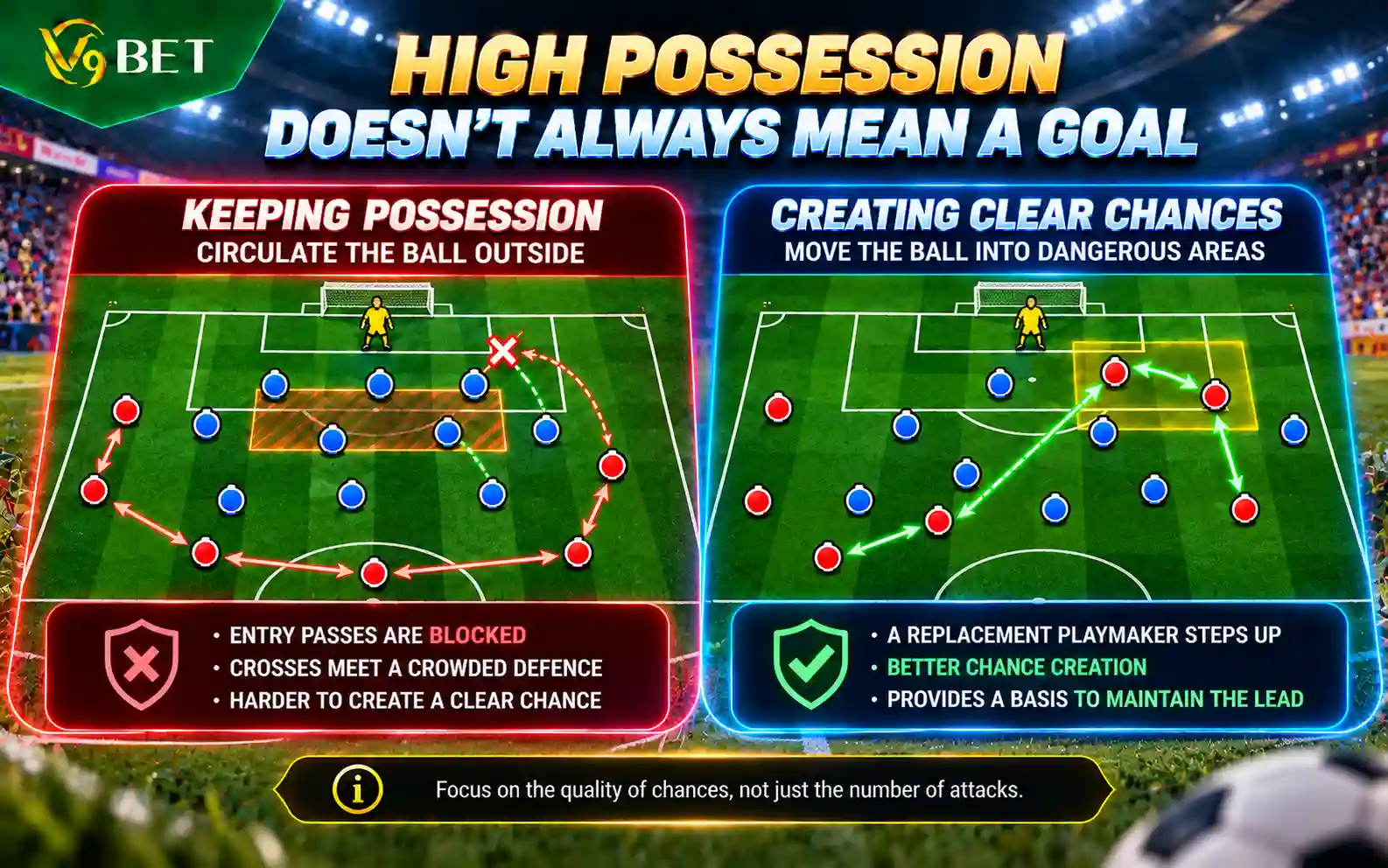
Two diagrams comparing circulation outside the penalty area with clear chance creation
Use xG to understand chances, not as a countdown clock to a goal
xG, or expected goals, is a tool that estimates the quality of finishing chances using a model. Hudl Statsbomb explains that factors may include location, angle, body part used to shoot, and the play that created the chance; each model can produce different values. Therefore, you need to know which data source you are using.
Accumulated total xG is not the number of goals a team still “owes.” A clear chance that was missed belongs to the past; it does not oblige the next chance to become a goal. When assessing the remainder of the match, what you need to observe is whether the mechanism for creating chances still exists or has been adjusted by the opponent. This is the limit to remember when moving from descriptive statistics to guessing what happens next.
|
Sign on the pitch |
Additional question to ask |
Cautious interpretation |
|
Dominant possession |
Where is the ball being kept? |
May control the match but pose little threat to goal |
|
Many shots |
Are the shots close or far, and under pressure? |
Shot volume alone does not reflect enough quality |
|
Consecutive corners |
Do they come from dangerous chances or blocked crosses? |
Cannot yet infer that a goal is about to appear |
|
Many clear chances |
Is the way chances are created repeatable? |
There is a basis to assess the attack, but the price still matters |
|
Opponent counterattacks frequently |
Is the pressing team losing balance? |
If there is a goal, it may not belong to the team with more possession |
Labels such as “dangerous attack” in apps also need to be read within the definition limits of the data source. If you do not know which events are counted in the metric, do not use it as a probability of scoring. Images and numbers should complement each other, especially when one side is telling a different story from the other.
Why waiting for odds to rise can make a selection less attractive
Waiting gives you more information, but it also takes away time for the desired outcome to happen. For a selection that needs another goal before the match ends, the clock is part of the equation. Odds rising before a goal has been scored may simply reflect that time is running out, not that a new bargain has appeared.
A fairly common hypothetical situation: early in the second half, Team A creates space thanks to a fresh winger. The viewer decides to wait for the price to rise further. By the time the price reaches the desired level, that player has been substituted, the opponent has added cover on the flank, and the match keeps getting stopped. The price is better numerically, but the foundation of the original view has weakened.
There is no fixed minute that suits every match. Match tempo, scoreline, substitution options, and actual time played all differ. Even when the remaining time is the same, a team that needs to win and a team that is content with a draw can organize the match very differently.
Added time needs to be updated from actual information rather than assumed with certainty. A match with many stoppages may lead viewers to expect a long amount of added time, but before the announcement, the number is not confirmed. After the added-time board appears, the market price may already have reflected that information.
Choose the right bet type before assessing the price
A view about the flow of play is only useful when attached to the correct betting scope. Match winner, handicap, total goals, and next goalscorer set different conditions. You should not switch to a different bet type just because the price looks more attractive while your original reasoning does not support it.
|
Viewer's assessment |
Scope to distinguish |
Risk of misunderstanding |
|
Team A plays better for the rest of the match |
Full-match result or remaining-time result |
Ignoring the opponent's existing score advantage |
|
The match may have more goals |
Total match goals or remaining goals |
Miscounting goals that have already been scored |
|
Team A can equalize |
Equalizer, match win, or handicap win |
Choosing a harder condition than the assessment |
|
Both teams speed up at the end of the half |
Current-half bet or full-match bet |
Expecting the wrong time period for settlement |
|
Team A attacks the flank a lot |
Corners or goals |
Treating two different event types as the same |
For in-play Asian handicaps, you need to read the specific rules of the selection regarding how existing scores are handled. Some forms calculate based on the remaining play; others have their own scope stated in the bet name or rules. You should not use a remembered rule from a previous market and apply it to every ticket currently displayed.
Quarter-ball handicaps can also split the stake into two parts and produce half-win or half-loss outcomes. Whole-number handicaps may refund when the result equals the line, depending on the exact bet type. If you cannot explain whether a ticket wins, loses, or is refunded under the possible outcomes, you do not have enough information to compare prices.
To practice observing within the context of a tournament, you can read the article reading match rhythm and live odds movement in the Champions League. The point to keep throughout is the link between your assessment and the conditions on the ticket, instead of switching from one side to another just because the match is exciting.
Tips for reading In-Play football odds after red cards, substitutions, and VAR
After a major event, you need to reassess the structure of the match before continuing to use your old view. A red card changes the numbers; a substitution can change the organization; VAR leaves the state of an important situation unsettled. All three can make the previous price meaningless for comparison.
A team with a man advantage does not automatically create more clear chances immediately. If the opponent drops deep, gives up some attacking intent, and focuses on covering the central area, space can become harder to exploit. Conversely, a team short a player but trailing may be forced to take risks. The numbers need to be placed next to the scoreline and the tactical choice.
Substituting a midfielder for a striker is also not enough to confirm the attack will improve. The team may add a player in the box but lose the player who delivers the ball there. You need to observe the actual positions after the substitution, who takes on the creative role, and how the opponent responds, instead of only reading position names on the team sheet.
When VAR is checking a goal or a possible penalty, you should treat it as an incomplete state. Before continuing your assessment, you need to confirm the decision, the score, and the updated time. The market reopening does not replace the step of checking whether you understand the match correctly and the new conditions correctly.
Latency can turn an apparently attractive price into a misunderstanding
The picture you see may be slower than the data used to adjust the odds. The Gambling Commission's guide on in-play betting notes that broadcast delay and bet processing time can create information gaps. This is the basis for being cautious with prices that seem not to match what is happening on screen.
If the odds board suddenly changes sharply while the picture still shows the ball in midfield, you cannot conclude that the bookmaker is “tempting” you in one direction. An event may have already happened before the stream displayed it. The appropriate response is to check the clock, the score, and the match state; do not guess the cause and then stake money on that guess.
The price at the moment you click is also not necessarily the price accepted on the ticket. When there is a waiting period or a request to confirm a change, you need to reread the final conditions and the transaction status. If it is unclear whether the ticket has been accepted, repeating the action may cause you to bet more than intended.
When viewing the odds board on V9Bet, you can refer to the article how to read the SABA Sports odds board to get familiar with the information you need to compare. Listing availability, rules, and processing times must be checked in the actual market; there is no data in this article to claim that one market is faster or has features that another does not.
Is “catching the best in-play bet” about entering at one fixed moment?
There is no fixed moment that guarantees catching the best in-play bet. A word-of-mouth minute range cannot replace information about the match you are watching. What matters more is knowing which conditions give your view a basis and which conditions force you to stop.
Suppose you are only interested in the possibility of more goals when both teams still have quality attacking organization. If one side switches to slow possession, continuous attacking moves break down in midfield, or the key chance creator leaves the pitch, the view must be revised. You do not need to wait for a losing ticket to admit that the context has changed.
Before considering a bet, express the reason in one verifiable sentence: which team is creating what type of chance, why it is likely to continue, and what information would disprove it. If the answer is only “it's about time there was a goal,” the reasoning is based on personal expectation. The match has no obligation to complete the viewer's script.
Keep stake limits when live odds keep creating opportunities to add more
The risk of in-play betting lies as much in the number of bets within one match. Each ticket may be small, but the total amount rises quickly if you react to every corner, shot, or odds change. Limits for one match and one session should be set in advance, using only amounts you can lose without affecting essential expenses.
Many tickets do not mean diversified risk. Backing Team A to win, Team A to score next, and Over total goals may all depend on Team A breaking down the opponent's defense. When that does not happen, the tickets are likely to be unfavorable together. You need to add up the entire amount at risk instead of evaluating each ticket separately.
After an unexpected loss, the urge to add more often comes before new evidence. Increasing stakes to recover what was lost does not improve the quality of your assessment. If you notice yourself choosing a different match, changing bet types, or accepting a worse price just to recover, you should stop the session instead of trying to find a football reason for that action.
The article on maintaining a stable betting rhythm when following BTi Live is related reading to continue with. A limit only has meaning when it is kept both when losing and when winning; money you have just won is not free money to stake more on a whim.
Expert conclusion
The secret to in-play football betting begins with correctly reading what is being priced: a specific outcome, over a specific period, with specific settlement conditions. Pressure needs to be checked through the quality of chances. Odds need to be placed next to probabilities that remain highly uncertain, the time remaining, and information latency.
A reasonable decision is not proven by a single winning ticket, nor is it necessarily disproven by a single losing ticket. What deserves evaluation is whether the facts are correct, the reasoning is consistent, and the risk level is within limits. When those three elements are not clear, continuing to watch the match without placing money is a perfectly valid choice.
Frequently asked questions
Does rising live odds mean it is a sign to bet?
No. Odds can rise because less time remains or because events are unfavorable to the selected outcome. Looking only at the price while ignoring the change in probability will cause you to misjudge the value of the selection.
If a team presses a lot, should you immediately back Over?
Not enough basis. You need to see whether that team creates clear chances, whether the opponent can counterattack, and what the current total-goals line requires. Many crosses blocked from distance can create the feeling of excitement but pose little threat to goal.
Is there any minute that is easier for in-play betting than all others?
There is no general rule that guarantees an edge at a fixed minute. At the same moment, two matches can be completely different in score, personnel, and organization. Waiting for a minute marker is only useful if it serves to verify a specific view.
Can the formula 1 divided by odds be used for every Asian handicap?
No. The simple formula in this article is for decimal odds with two states, win and loss, with no refund or partial settlement. Asian handicaps have other states that require separately calculating probability and the corresponding payout.
Why is the price on the ticket different from the price I just saw?
During the action or processing time, the market may have changed. You need to check the notification, the confirmation conditions, and the price actually accepted on the ticket. You should not infer that the ticket was successful just from clicking the bet button.